


Batukamma Celebrations


Sri Maatre Namaha!
Bathukamma – The Divine Celebration of Nature, Shakti and Life
“Bathukamma – May the Mother Goddess live forever, may nature flourish, and may prosperity bless every home.”
1. The Divine Essence of Bathukamma
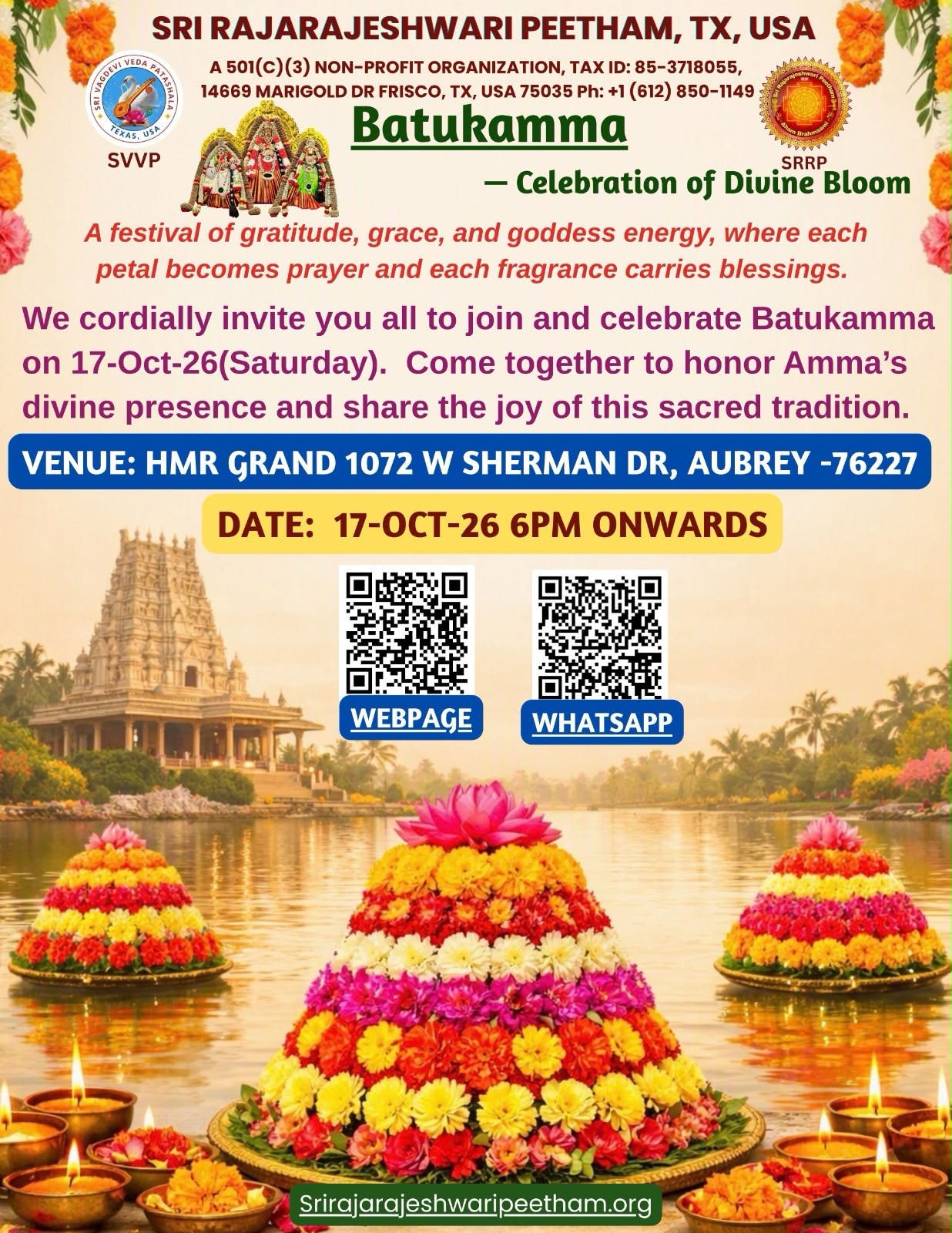
Bathukamma is one of the most colorful, vibrant, and spiritually significant festivals of Telangana, celebrated during Sharannavaratri in the sacred month of Ashwayuja. Adorned with beautiful seasonal flowers that bloom across the Telangana landscape, Bathukamma is a magnificent expression of devotion to the Divine Mother, gratitude to nature, and reverence for the life-giving power of Shakti.
The word Bathukamma carries a beautiful prayer within itself — “Bathuku Amma,” meaning “Mother, may you live” or “O Mother, bless us with life.” It is an invocation for the well-being of the Divine Mother, the prosperity of families, the flourishing of nature, and the continuity of life.
Women gather around intricately arranged floral Bathukammas, singing traditional songs, clapping, and dancing in joyful circles. The festival brings communities together in devotion, celebrating the sacred bond between the Goddess, Mother Earth, and all living beings.
Beyond its vibrant appearance, Bathukamma carries profound spiritual symbolism. Its nine-day observance, layered floral structure, turmeric representation of the Goddess, and concluding immersion reflect the divine presence in nature and the eternal cycle of creation, sustenance, and renewal.
2. Boddemma – The Sacred Prelude to Bathukamma
Before the commencement of Bathukamma, the people of Telangana observe Boddemma, a traditional worship associated with Mother Earth and the transition into the sacred festive period.
Boddemma is traditionally fashioned from puttamannu (natural clay or earth), arranged into five or seven tiers representing the Divine Mother. The observance concludes before Amavasya, leading into the nine-day celebration of Bathukamma.
In local devotional tradition, Boddemma is associated with Jyeshtha Devi, who is believed to remove negativity and carry away inauspicious influences, symbolically cleansing the earth and preparing it for renewal.
The word Boddu means the navel or center. Symbolically, the navel represents the source from which creation emerges, while Mother Earth represents the nurturing foundation of all life.
A traditional interpretation also connects the sequence of Boddemma and Bathukamma with the Samudra Manthana, or the cosmic churning of the ocean. In this sacred narrative, Jyeshtha Devi appears before Lakshmi Devi, offering a devotional explanation for honoring Boddemma before celebrating Bathukamma.
Thus, Boddemma represents purification and preparation, while Bathukamma celebrates auspiciousness, abundance, and the flourishing of life.
3. Bathukamma – The Divine Mother in Floral Splendor
Bathukamma is worshipped as a manifestation of the Divine Mother, associated in devotional traditions with Gauramma, Goddess Parvati, and Lakshmi Devi.
The floral arrangement is the heart of the celebration. Seasonal flowers are carefully layered on a round wooden base or bamboo frame, forming a beautiful, symmetrical pyramid resembling a temple Gopuram.
Flowers of different colors, shapes, and fragrances are arranged in concentric tiers, transforming nature's simple offerings into a magnificent expression of devotion. At the pinnacle, a symbolic representation of the Goddess is placed, traditionally fashioned from turmeric and known as Gauramma.
The turmeric Gauramma represents the auspicious presence of the Mother Goddess, while the floral tiers symbolize the abundance, beauty, and sacred order of creation.
Bathukamma reminds us that flowers are not merely offerings of beauty; they are expressions of gratitude to the natural world through which the Divine manifests.
4. Sacred Legends and the Origin of Bathukamma
Legend 1: The Divine Birth of Bathukamma
According to one popular legend, Bathukamma was born as the daughter of Chola King Dharmangada and Queen Satyavati. The royal couple had lost their hundred sons in battle and prayed fervently to Goddess Lakshmi, seeking her blessings for a daughter.
Moved by their devotion, Goddess Lakshmi was born to them as a daughter. When sages and holy men arrived to bless the child, they wished her a long, prosperous, and auspicious life.
Their blessing became the name “Bathukamma” — “May you live forever!”
This legend celebrates the triumph of hope over sorrow and the arrival of divine grace into a grieving family. Bathukamma thus becomes a prayer for longevity, happiness, prosperity, and the well-being of every household.
Legend 2: The Awakening of Goddess Gauri
Another popular legend connects Bathukamma with Goddess Gauri's victory over the demon Mahishasura.
After a fierce battle and the destruction of the demon, Goddess Gauri is believed to have fallen into a deep, exhausted sleep. Her devotees prayed earnestly for her to awaken, chanting:
“Amma, Bathuku!” — “Mother, please rise and live!”
On the tenth day, Vijayadashami or Dasami, the Goddess awakened, bringing joy and renewed hope to her devotees.
This legend gives Bathukamma a profound spiritual meaning: the awakening of divine energy, the restoration of auspiciousness, and the victory of Shakti over destructive forces.
Legend 3: The Vemulawada Connection
A regional legend associates Bathukamma with the historic Sri Raja Rajeshwara Temple at Vemulawada in Telangana.
According to this tradition, Vemulawada was once ruled by the Kalyani Chalukyas, who were feudatories of the Rashtrakutas. During conflicts involving the Cholas and Rashtrakutas, the Chalukyas supported the Rashtrakutas.
Parantaka Chola is traditionally described as a devotee of Raja Rajeshwara. The legend further associates his grandson Rajendra Chola's campaign against the Chalukyas with the removal of the great Shiva Lingam from Vemulawada as a symbol of victory.
The loss of the sacred Lingam is said to have caused great sorrow among the people. To console Goddess Parvati, who is worshipped at the temple as Bruhadamma, devotees are believed to have created a beautiful floral arrangement resembling Mount Meru.
This tradition connects Bathukamma with the worship of the Divine Mother and the symbolism of Mount Meru, the sacred cosmic center in Hindu spiritual traditions.
While historical accounts and regional traditions may differ in their details, this legend remains a meaningful expression of Telangana's devotional heritage and the enduring relationship between Bathukamma, Vemulawada, and the worship of Shakti.
5. The Nine Sacred Days of Bathukamma
Bathukamma is celebrated over nine days, beginning with Chinna Bathukamma on Ashwayuja Amavasya and culminating in the grand celebration of Saddula Bathukamma.
Each day has its own traditional name, ritual significance, and offering (prasadam). These offerings reflect simplicity, gratitude, nourishment, and the sacred relationship between people and nature.
Day 1 – Engili Pula Bathukamma
Traditional offering: Sesame seeds and rice flour, according to local custom.
The first day marks the beginning of the Bathukamma celebrations on Amavasya. Devotees prepare the floral arrangement and offer simple traditional foods to the Goddess, seeking blessings for the days ahead.
Day 2 – Atukula Bathukamma
Traditional offering: Atukulu (flattened rice), boiled lentils, and jaggery.
The second day celebrates nourishment and sharing. The offering represents the simplicity of traditional food and the spirit of devotion expressed through humble ingredients.
Day 3 – Muddapappu Bathukamma
Traditional offering: Cooked dal, milk, and jaggery.
This day emphasizes nourishment, sweetness, and maternal care. The offering symbolizes the wish for peace, well-being, and prosperity in every home.
Day 4 – Nanabiyyam Bathukamma
Traditional offering: Soaked rice, milk, and jaggery.
Rice, milk, and jaggery are offered as symbols of nourishment, abundance, and auspiciousness, expressing gratitude for the blessings that sustain life.
Day 5 – Atla Bathukamma
Traditional offering: Atlu or dosalu (traditional pancakes or dosas).
The fifth day celebrates the Goddess through a familiar household preparation, reflecting the close relationship between worship, food, and family traditions.
Day 6 – Aligina Bathukamma
Traditional observance: No special food offering is traditionally prepared on this day in the custom described here.
Aligina Bathukamma marks a distinct pause in the sequence of daily offerings. Customs may vary by family and region, and the day is observed according to local tradition.
Day 7 – Vepakayala Bathukamma
Traditional offering: Rice flour and jaggery shaped like neem fruits.
The offering recalls the form of neem fruits and celebrates the symbolic connection between traditional food practices, the natural world, and the Divine Mother.
Day 8 – Vennamuddala Bathukamma
Traditional offering: Balls prepared with butter, sesame seeds, and jaggery.
This sweet and nourishing preparation is offered with devotion, symbolizing affection, abundance, and the loving grace of the Mother Goddess.
Day 9 – Saddula Bathukamma
Traditional offering: Saddulu prepared with sesame, curd, lemon, tamarind, and coconut, according to tradition.
Saddula Bathukamma is the grand culmination of the nine-day celebration. Women gather in large circles around their beautifully arranged floral Bathukammas, singing traditional songs, clapping rhythmically, and dancing together in joyful devotion.
The celebration concludes with the ceremonial immersion of Bathukamma in a water body, symbolizing the return of the flowers to nature and the continuous cycle of creation and renewal.
The turmeric representation of Gauramma is respectfully retrieved, and women traditionally apply the turmeric to their foreheads as an auspicious blessing.
Saddula Bathukamma is a beautiful expression of collective devotion, cultural heritage, feminine energy, and gratitude to Mother Nature.
Note: Names, offerings, and local observances can vary among families and regions of Telangana. The traditions followed by the Peetam may be presented as the prescribed custom for its devotees.
6. Bathukamma and the Sri Chakra Navavarana – A Sacred Inner Connection
Bathukamma is celebrated outwardly as a vibrant floral festival, yet its nine-day observance and layered floral arrangement also invite a deeper spiritual contemplation through the philosophy of Sri Vidya and the worship of Sri Chakra.
In Sri Vidya tradition, the Sri Chakra or Sri Yantra is a sacred geometric representation of the Divine Mother, Maha Tripura Sundari. Its nine enclosures, known as the Navavarana, represent progressively deeper dimensions of spiritual realization, culminating in the supreme unity of the Divine Mother at the Bindu.
The relationship between Bathukamma and Sri Chakra Navavarana can be understood as a symbolic and devotional parallel.
The Nine Floral Tiers and the Nine Enclosures
The flowers of Bathukamma are arranged carefully in ascending, concentric layers, forming a pyramid-like structure reminiscent of a temple tower. Each layer contributes to the beauty and completeness of the whole.
Similarly, the Sri Chakra contains nine enclosures, each associated with a distinct dimension of divine power and spiritual contemplation.
The layered floral arrangement of Bathukamma can therefore serve as a beautiful visual meditation on the sacred order of creation and the seeker's inward journey toward the Divine Mother.
Gauramma at the Pinnacle – The Bindu Principle
At the very top of Bathukamma rests the symbolic representation of Gauramma, often made from turmeric.
In Sri Chakra worship, the innermost point, the Bindu, represents the supreme center of divine consciousness and the abode of Maha Tripura Sundari in Sri Vidya tradition.
The placement of Gauramma at the pinnacle of Bathukamma offers a meaningful symbolic parallel: just as the Bindu is the central point of the Sri Chakra, the Goddess crowns the floral arrangement as the sacred presence around which the entire offering is formed.
The flowers represent the many expressions of creation, while the Goddess represents the divine source and sustaining power of all life.
The Nine Days and the Spiritual Journey
The nine days of Bathukamma can also be contemplated alongside the nine enclosures of Navavarana Puja.
In Sri Vidya practice, the Navavarana worship proceeds through the nine enclosures toward the Bindu, representing a movement from the outer dimensions of existence toward deeper spiritual realization.
Bathukamma's nine-day celebration similarly invites devotees to move beyond the beauty of the external festival and reflect on the Divine Mother within all creation.
Although Bathukamma is not itself identical to the formal ritual sequence of Navavarana Puja, the two can be appreciated together through their shared symbolism of ninefold sacredness, divine feminine energy, and the central presence of the Goddess.
Bathukamma as Worship of the Divine Mother
Through this spiritual perspective, Bathukamma becomes more than a floral festival. It becomes a reminder that the entire universe is an expression of Shakti — the dynamic power of the Divine Mother.
The flowers, the earth, the water, the food offerings, the singing, and the collective devotion all become expressions of gratitude to the Goddess who nourishes and sustains life.
For devotees who follow Sri Vidya, Bathukamma can be an especially meaningful occasion to contemplate Maha Tripura Sundari, the Sri Chakra, and the unity of the Divine Mother with the entire cosmos.
7. Bathukamma – A Celebration of Nature and Sacred Womanhood
Bathukamma beautifully expresses the understanding that nature itself is sacred.
The seasonal flowers used in its creation remind us of the earth's generosity. Traditional food offerings express gratitude for nourishment. The immersion of the floral arrangement symbolizes the return of nature's gifts to the natural world.
The gathering of women in circles reflects unity, shared devotion, cultural continuity, and the strength of the feminine spirit.
Bathukamma also preserves Telangana's rich oral traditions through songs that celebrate the Goddess, family relationships, local history, village life, and the rhythms of nature.
It is a festival that brings together devotion and ecology, spirituality and community, ancient traditions and living culture.
Through Bathukamma, devotees are reminded to honor Mother Earth, cherish the natural world, preserve traditional wisdom, and recognize the Divine Mother in all forms of life.
8. The Divine Blessings of Bathukamma
May the grace of Gauramma and the Divine Mother bring health, happiness, and prosperity to every family.
May Mother Earth remain fertile and flourishing, may nature's abundance be protected, and may every home be filled with peace and auspiciousness.
May the spirit of Bathukamma awaken devotion in our hearts, strengthen our connection with the Divine Mother, and inspire us to live in harmony with nature and one another.
Jai Gauramma! Jai Bathukamma! Jai Mata Shakti!
Register Faster with Your SRRP Profile
Create your SRRP Profile once and save your personal and family information for future events. Your details can be automatically filled in whenever you register.
- Save your contact and address information
- Save Gothram, Raasi and Nakshatram details
- Add and manage family members
- Auto-fill details for future SRRP registrations
Participant Details


